Mustang throttle position sensor


|
Mustang throttle position sensor
|
|
12/15/2009 small revisions in wording 7/15/2011 expanded slightly. Added geometric mean of idle voltage Throttle Position Sensor TPS
Engineering specifications:
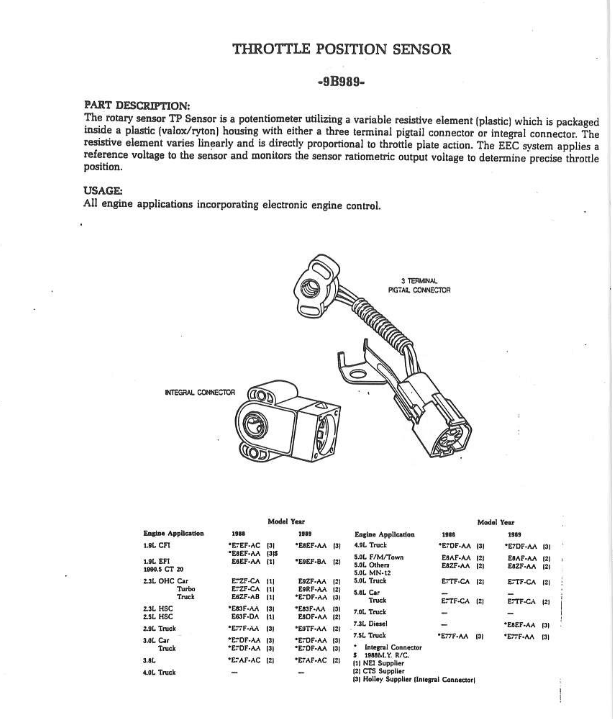
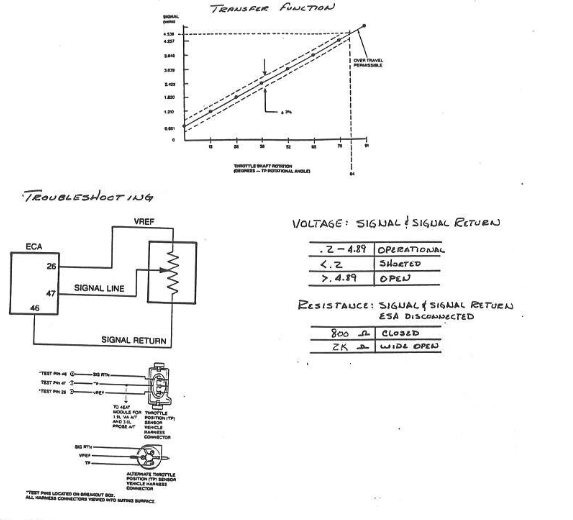
The Mustang Fox body throttle position sensor (TPS) uses a floating ground-return to the computer. The only throttle position sensor ground is at the computer. (DO NOT ground the TPS on the engine or anywhere else!) Because the TPS ground floats from the engine, the proper place to measure TPS voltages are between the TPS black ground wire and the other TPS wires. We should not measure between some engine part and the TPS wires, or between the vehicle chassis and the TPS wires. If a TPS wire or connection is open, or if the TPS is defective, it will show by measuring between TPS wires. The throttle position sensor has three wires, voltage source, sensor output, and ground return. The floating ground return keeps "ground loop" voltages, like unwanted small voltages from engine-to-chassis, from influencing the TPS reading.
Voltages you should see at the TPS (throttle position sensor), with ignition key on and the engine not running, are: Orange to black without the TPS connected.....5.0 volts nominal. This is a computer-supplied, regulated, reference voltage. The TPS must have 5.0 volts nominal between orange and black to work. 4.9 volts is OK, as is 5.1 volts, if the voltage is steady. Green to black without the TPS connected....anything from 0 to 5 volts. The green wire voltage, without the TPS connected, is unpredictable. This is because the green wire connects to the computer's TPS input pin. The voltage on this wire depends on the sensor dividing voltage down from the 5 volt Orange line. The green wire is very sensitive to leakage resistances when the TPS is unplugged, so it can give an erratic reading. If the unplugged reading is outside the range of 0-5 volts, you might have an electrical connector moisture problem. It should be somewhere between zero and 5 volts. Black to vehicle chassis, timing chain cover, bell housing, or engine block....less than 0.5 volts under any operating condition.
The stock computer allows this idle voltage range for the EEC-IV A9L:
Because of meter and component tolerances, you never want to go outside the range. Anything inside the range above will run exactly the same.
With the TPS connected, idle-position voltages should be.... Orange to black......5.0 volts NOMINAL depending on your meter. This is the supply voltage from a voltage regulator inside the EEC. Green to black........absolute maximum range of 0.6 volts to 1.15 volts, 0.8 to 0.85 volts is very good at idle. This is sensor output. Green to black with accelerator floored....at least 3 volts higher than the green to black idle voltage! Black to vehicle chassis, timing chain cover, bell housing, or engine block....less than 0.5 volts under any operating condition. This is sensor ground. The voltage from the green wire to the black wire should smoothly vary from idle voltage (0.6-1.1 volts) to over 4 volts at WOT. The voltage change as the throttle is opened or closed should be smooth. The voltage should follow the throttle position. If the voltage jumps around at some throttle positions, the TPS is probably bad. If the voltage on the green wire is stuck high or low and the rest are normal, it is probably a bad sensor. Optimum TPS Voltage Setting The stock computer reads the TPS voltage, and remembers it, when the key is initially turned on. Any green to black wire voltage between 0.6 and 1.15 volts is considered an acceptable idle (closed throttle) voltage. Ford intentionally allowed a fairly wide range of voltages. After all, each car in production will be slightly different. With a wide range of voltages, the factory and dealerships did not have to worry about setting TPS voltage for each individual car....and nether do we. There is some crazy idea we have to set the TPS to some specific voltage, or that a different TPS idle voltage will change engine response, idle, or power. It makes no difference at all what the voltage is, so long as it is within the allowable range of voltages. Performance, idle quality, and throttle response will not change with any setting within the allowed range. In some cases, especially if it makes us feel good (the car won't care one bit), we might want to center the TPS voltage. When we want to center something between an upper and lower limit, the ideal center point choice is not the simple average (although average is close) or middle of the range. Centered is not an exactly equal amount above and below the extremes. The perfect or ideal center point is actually the geometric mean . The geometric mean creates the same proportion or percentage of voltage tolerance above and below some point. This is the real center or middle of a range. The geometric mean of .6 and 1.15 is the square root of .6*1.15. This is 0.83 volts. 0.83 volts is the same percentage below 1.15 volts as it is above .6 volts. 0.83 volts is the geometric middle of the numbers when we look at possible voltage errors or "drift". The average would be .6+1.15 /2 = 0.875 volts, but this would be off (a little above) the geometric center. In this case, voltage is closer to the upper limit than the lower limit, as a tolerance percentage error. When we go 0.9 volts or higher, it gets even worse. No matter what advice you read, do not intentionally set your TPS at some voltage near a limit! If you do that, if your meter is off, or if the resistor in the TPS ages or gets a little dirty, or if some connection gets just a little bad, the TPS can move out of idle range more easily. The best idea is the center for a target. Part Throttle Part throttle is any voltage between wide open throttle and idle voltage. There is some hysteresis designed in so we do not get false changes or bouncing between the three throttle states. Wide Open Throttle The stock computer is programmed internally to "think" WOT (wide open throttle) is 2.71 volts higher than the idle TPS voltage. This means if idle voltage is .75 volts, the computer assumes any voltage between the green wire and black wire of 3.46 volts or more is wide open throttle. (This is 2.71+.75 = 3.46 volts in this example of .75 volts idle voltage.) Let's say this again, because WOT is the most critical threshold we want to reach. Your car's idle voltage plus 2.71 volts is what the early Mustang computer thinks is WOT voltage. WOT is where the computer immediately transfers to open loop operation and where the computer ignores narrow-band factory oxygen sensors. For the computer to be fully "safe and solid" into WOT, not teetering near the edge where electrical fluctuations might make the computer drop out of WOT mode, the TPS voltage, with wide open throttle, should be at least 0.25 volts above threshold voltage. This means we want: idle voltage+2.71+.25 , or you car's idle voltage plus 2.96, as the very minimum WOT voltage. When you hold the "pedal to the metal", you must have more than 3 volts between the green and black wires!
Be absolutely sure to check WOT voltage. My 1989 LX initially was OK at idle, but because of a defective throttle sensor, never went into WOT open loop mode! The most important test: As the accelerator is slowly moved there should be a smooth steady change on the green without any sudden jumps in voltage. This is best seen on an analog meter (one with a moving needle)! This is important for the acceleration enrichment to work, and for functions that depend on the relative throttle position. Remember, the computer considers a range centered on 0.812 volts as "idle". The computer also considers anything more than 2.71 volts above actual idle voltage as wide open throttle, but we should add a little extra voltage to WOT position to be safe. Contrary to claims or rumors, it doesn't matter what the TPS is set at for idle so long as it is between .6 volts and 1.1 volts. The computer will not produce better idle, better response, more stable idle, or better fuel economy if you set at any specific voltage in the acceptable range. My Background I was a Ham radio operator when I was 12 years old. I built my own transmitters and receivers from old junk radio and television carcasses I brought home from the local dump. Reading books and building things taught me how electronics systems worked. I built my first tachometer from scratch when I was 13 years old. This was about 1964. I put this in my dad's '57 Ford. My hand-made tachometer used brand new devices called "transistors" (most stuff was still vacuum tubes back then) and a meter from a WW II surplus radio set. At that time I was also repairing car radio's for the teenagers next door to me, including hand-making solid-state tubes to replace the troublesome 0Z4 gas rectifier tubes used in car radios. The older teenagers next door, especially Tom Hilding, got me interested in cars. Tom had a '62 Chevy II with six-cylinder flags, but it had a dual quad small block and four speed. It would go sideways in the first three gears (mostly due to the bad tires back then). This started me out in life thinking sleeper cars were the best cars to own. Like most red-blooded American's who grew up in the 60's and 70's, I love American muscle cars of all types. I have owned American Motors, Chevy, Studebaker, and Ford muscle cars, but mostly when they were available used and cheap. I have primarily design analog systems for the past 40 years, along with some digital systems. I have designed commercially manufactured after market solid-state ignition systems, as well as metering, instrumentation, and automotive test equipment. I managed engineering in the precision meter manufacturing division of a large aftermarket gauge and test equipment supplier. We supplied test equipment to Sun, Sears, Mac Tools, Snap-On, and many others. I still design manufactured products, including studio audio, medical, and consumer communications equipment.
|