Also see: Receiving Antenna Design
To see world QRN (from past NASA data): Lightning world map

To see USA Lightning: Lightning
To see my local QRN (nearly real time): Lightning USA Map
Noise
Noise primarily limits our ability to hear weak signals on lower bands. The noise on lower bands is often an accumulation of many signal sources that combine to establish our noise floor. Below 18 MHz, noise we hear on our receivers (even at the quietest sites) comes from terrestrial sources. This noise is generally a mixture of local groundwave and ionosphere propagated noise sources, although some of us suffer with dominant noise sources located very close to our antenna systems.
Sometimes we don't do ourselves any favors. We might not pay attention to common mode currents on cables, or we might not locate our antennas in the best locations possible...away from local noise sources.
Some of us are fortunate enough to live in quiet locations, where the dominant noise propagates in from a distance. My local noise level on quiet night from a northeast direction is -127dBm, 350Hz BW. This is from a pair of ~800ft long broadside Beverages spaced around 375ft between antennas. This is pretty quiet, actually allowing me to hear signals transmitted in the microwatt range at 1000 miles on 160 meters!
Locations
Our locations fall into three basic "radio" categories that may or may not be related to our actual communities:
Note: noise levels quoted in this text are the average of three independent studies by Bell Labs, FCC Land Mobile Advisory committee, and the Institute for Telecommunication Sciences. Rural data are actual measurements of summer noontime and winter midnight noise at my location, several miles from high voltage transmission lines and far from any industrial or suburban populations.
Urban
In urban-type noise situations, noise arrives from multiple random sources through direct and groundwave propagation from local sources. One or more sources can actually be the induction-field zone of our antennas (in most cases the induction field dominates at distances less than 1/2l). Urban locations are the least desirable locations because typical noise floors average 16dB higher than suburban locations. High noise levels are present both day and night, under all different propagation conditions. There is often no evidence of a winter nighttime noise increase on 160 meters, since ionosphere-propagated noises are swamped out by the combined noise power of multiple local noise sources. Much of the noise comes from electrical distribution lines, because of the large amount of hardware required to serve multiple users. Other noise sources are switching power supplies, arcing switch contacts or loose electrical connections, and other unintentional man-made noise transmitters.
Suburban
Reports and studies indicate suburban locations average about 16 dB quieter than urban locations, and are typically about 20 dB noisier than rural locations. Noise generally is directional, arriving mostly from areas of densest population or the most noise-offensive power lines. Utility high-voltage transmission lines are often problematic at distances greater than a mile, and occasionally distribution lines can be problems. The recent influx of computers and switching power supplies have added a new dimension to suburban noise.
There is often a small increase in nighttime winter noise, when compared to daytime noise levels, at quieter suburban locations. This increase occurs when the accumulation of many ionospheric propagated terrestrial noise sources equals or exceeds the sum of multiple local direct or ground wave propagated noise sources.
Rural
Rural locations, especially those miles from any population center, offer the quietest environment for low-band receiving. Studies have show daytime 160 meter noise levels are typically around 35-50 dB quieter than urban, more than 20 dB quieter than suburban locations. Nighttime brings a dramatic increase in low-band noise, as noise propagates in via the ionosphere from multiple distant sources.

Primarily, rural electrical local noise comes from electric fences, switching power supplies, and utility lines. During daytime on 160 meters, I can measure a 3 to 5dB noise level increase in the direction of two population centers; Barnesville (population 7500 and distance 6 miles) and Forsyth (population 10,000 and distance 7 miles) Georgia.
Typical daytime noise levels, measured on a 200-foot omni-directional vertical, are around -130 dBm with a 350 Hz bandwidth (noise power is directly proportional to receiver bandwidth). On QRN-free winter nights, noise power increases from daytime levels by about 5 to 15 dB when the band "opens". As in the case of suburban systems, directional antennas reduce noise power. This noise power reduction comes because directional antennas focus or collect noise from a smaller area of propagated noise.
Nighttime is an "equalizer" between suburban and rural locations, with the skywave noise reducing the advantage of quieter locations. This is because noise propagated via the ionosphere from distant sources increases that largest amount in naturally quiet locations under improved nighttime propagation.
Noise Polarization
Noise is generated by randomly polarized sources. Noise polarization is filtered by the method of propagation.
Noise arriving from the ionosphere is randomly polarized. It arrives at whatever polarization the ionosphere happens to favor at the moment. It has the same ratio of electric to magnetic fields (also called field impedance) as a "good" signal.
Sources within a few wavelengths of the antenna combine and produce a randomly polarized noise. Local noise generally has no particularly dominant field. Very local noise, in the nearfield of the antenna, can either be electric or magnetic field dominant.
Noises arriving from groundwave sources some distance from the antenna are vertically polarized. This relatively fixed polarization occurs because the earth "filters out" horizontal components. Horizontal electric field components are "short circuited" by the conductive earth as they propagate and are eliminated, and since removing the electric field attenuates the magnetic field (they are inseparable in radiation) any horizontally polarized components from distant groundwave sources are quickly attenuated.
Electric (E-field) vs. Magnetic (H field) Field Impedance
We often hear things about high E-field (electric field) response being bad and a low E-field response being good for rejecting noise. Another thing we might hear is that loop antennas are "magnetic", and the magnetic field is good for desired signals while rejecting undesired noise. Along the same lines, we sometimes hear a "shielded loop" rejects noise while good signals pass right through the shield walls. In fact none of these explanations are technically accurate.
Here is something that might surprise people, but is absolutely true. At distances more than 1/10th wavelength, a magnetic loop actually responds better to electric fields than it does to magnetic fields! As distances increase to 1/2 wavelength and beyond, the electric and magnetic fields even-out. At enough distance, field impedance becomes fixed at the impedance value (or field ratio) of freespace regardless what the source or receiving antenna actually is. The graph below shows the field ratio or field impedance of a small "magnetic" loop and a very small dipole:
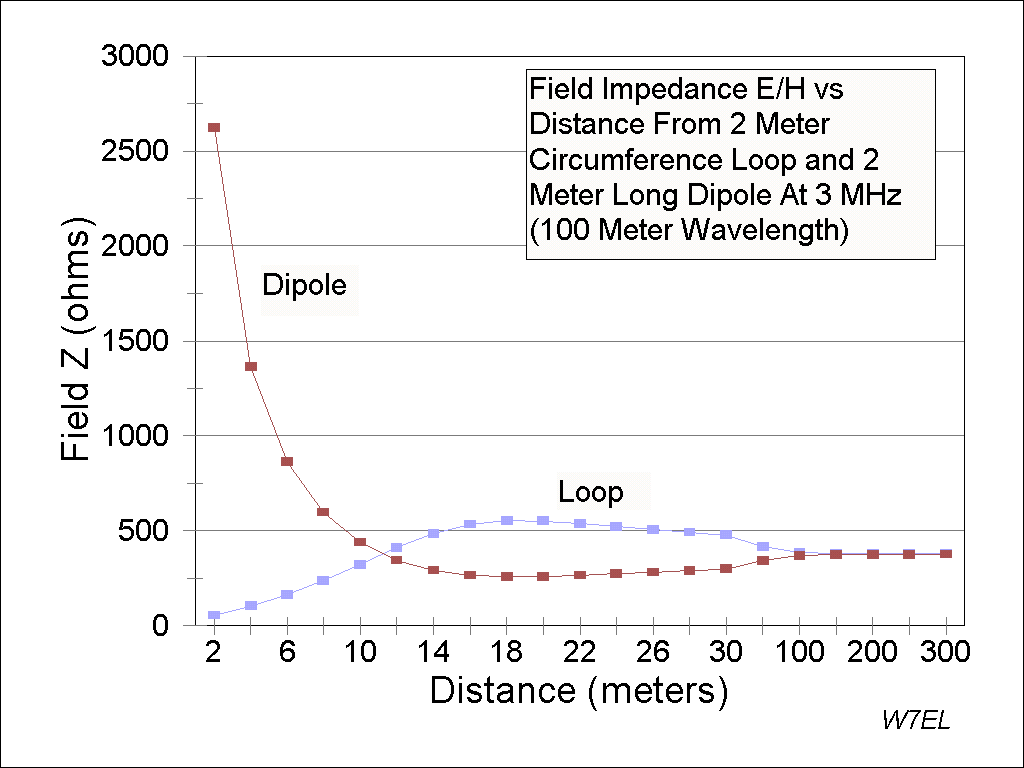
The loop field impedance shown in this graph is unchanged by a shield.
The difference in noise response between a magnetic loop and a small voltage probe is actually caused by the amount of common mode rejection of unwanted feed line conducted signals. The overall antenna pattern also has a large effect. At any given location, it is possible either an electric field probe (very small dipole or monopole) or a magnetic loop will be "quieter". Which system works best depends on local near-field noise field impedance and how the antenna is constructed. There isn't anything that causes one field to always be the dominant field of noise sources.
There is something that makes loop antenna generally appear to work better. It is much easier to build a "magnetic loop" that is decoupled from the feed line (which connects to noise sources) than it is to build a voltage probe that is properly decoupled.
Field impedance noise rejection is probably one of the deepest rooted falsehoods in amateur and SWL receiving.
Follow these rules for receiving antennas:
- With small magnetic loop antennas, make sure the antenna is properly balanced
- Lay feed lines directly on earth or bury feed lines in the soil so earth losses reduce shield current and limit feed line common mode impedance
- Be sure shield connections are properly made and snug
- If noise levels are high or antenna sensitivity is very low, isolate the feed line from the antenna as it approaches the antenna by using choke baluns
- Ground the feed line a few dozen feet away from the antenna
- Avoid autotransformers. Instead use isolated primary and secondary isolated winding transformers
- Use an independent ground on the antenna. Never connect an antenna signal ground to the coaxial cable shield!
To hear a demo of noise and directivity, go to the DX Sound page.
©2003 W8JI