|
Do NOT burnish or file low-current relay contacts! Using any abrasive, even a mild abrasive on low or medium current relay contacts will damage the relay. Avoid greases or coatings that collect dirt or dust, because the actual problem is rooted in a very thin layer of insulating contaminants. Low or medium current relays almost always have a thin gold or silver flash. This overlay prevents oxidation and improves low current connections. The flash or plating is easily removed, and if it is removed, low signal level connection issues will reappear quicker. |
Related Pages
There is a tendency to immediately blame the relay (and switches) for any amplifier or antenna switch problem, from high input SWR to intermittent output.
Relays (and switches) almost never cause input SWR issues or intermittent operation during transmit in an amplifier or antenna switch. Despite the rarity of contact problems during transmission, it is common to immediately rush forward and physically "clean contacts" as a first step.
Physically cleaning low-to-medium current switch and relay contacts generally should be one of the last things done for transmitting problems.
This isn't to say a badly pitted contact, or relay that has been physically or electrically abused or damaged, cannot cause faults during transmission periods. There are rare cases where a relay or switch contact can cause intermittent transmitting, but such cases generally indicate a relay or switch so severely damaged replacement is a better solution. A transmitting failure rarely occurs in a relay or switch that has not subjected to some extraordinary physical or electrical abuse, like lightning, arcs, or repeated hot-switching.
Unnecessary cleaning often leads to life and reliability problems. Cleaners themselves can contaminate ceramics in high power switches, reducing voltage breakdown. Misplaced lubricants also catch and hold dust and dirt, reducing voltage breakdown. Even worse, cleaning can remove contact plating or flashing that aids low-level receive signal connections.
Intermittent connections causing sporadic weak receive signals can occur anywhere in a receiving system. The bad or intermittent connection might be inside the antenna system, in a coaxial connector, or anyplace between the antenna and receiver input components.
Connections are often healed by momentary application of transmit signal through the poor connection.
Intermittent receive is almost always caused by a poor pressure-connection, where the receiver signal path depends on pressure to form a good low-resistance electrical bond. This might be unintentional, perhaps a poor solder joint in an antenna or connector. It also might be in an intentional pressure connection, like a crimped connection or even in a connector.
There are multiple sources of trouble like this, and we are always much better off using rational, logical, trouble-shooting techniques to locate the bad connection.
Skip To Correcting Relay Receive Problems
Intermittent connections in any pressure contact, from relays to large switches, is almost always aggravated by low or zero current. These poor connections almost always heal at the first application of RF power. It is actually very rare for switches and relays to open while carrying high power. It is very common for them to develop open or poor connections with very low voltages and currents, such as when receiving signal or panel meter currents pass through them.
One way to clear a bad connection on receive is to "bump" the relay receive path with a little power. If the receive drops down, or drops out, from a bad connection in an amplifier relay, place the amplifier on standby and bump the system with normal exciter RF. This will often heal the relay, although often only temporarily. Another way to clear a receive fault is by application of a dc "wiping" current while cycling the relay. This will often restore receiving for a longer period. You'll see why below.
Order of Relay Problem Occurrences
The following data is from my 30+ years in manufacturing engineering, 45 years in repair and service, and 48 years building equipment. Much of my experience comes from companies like Ameritron, who have sold more remote antenna switches and amplifiers than any other company by far. For example, while I was general manager of Ameritron at Prime Instruments, we sold about 100 antenna relay systems and over 50 amplifiers per month. More than 500 RF switching relays went out every month. While I cannot disclose current numbers and products, I currently have access to data on relays numbering well into the thousands every month. This gives a good database for relay problems.
In order of failure, properly sequenced and non-abused relays have the following issues:
1.) Lack of continuity on receive. This is the largest failure by a very considerable amount, accounting for around 90% of all relay field problems (based on service and warranty history). This is a well-documented industry-wide problem.
2.) Welding or contact pitting from lightning, tube arcs, or hot switching. This is around 9 or 10 percent. This number has gone up with the proliferation of Chinese tubes, which have an unusually high arcing problem. At times it is customer induced (switching an antenna switch while transmitting), equipment induced (radios that switch while RF is present), or lightning induced.
3.) Mechanically induced problems from mechanical shock (dropping the item or device) or mechanical abuse (installing a cabinet screw that pushes into the relay). This is a very small number, requiring careless handling or human error.
4.) Open coils. This is very rare, but it happens.
5.) Contamination of pole pieces with oxides or deposits that causes the moving armature piece to lodge against the pole and stick. This has happened a few times with the rotor on my large tower. The cure is a shot of WD-40 on the magnet pole (not the contacts) and drawing a thin hard cardboard back and forth between the magnet pole and armature, while forcing the armature down by hand. I initially thought this was a magnetized pole, because the pole appeared "sticky", causing the pole to capture and hold the armature.
By far the most common relay problems or outright failures are lack of receive, or high resistance receive connections. Now let's look at a few common claims or causes I have never seen:
1.) Weakening of beryllium copper contact carriers by flexing. I have seen excessive current heat beryllium copper contact bars to the point of discoloration. I have found a few relays particularly sensitive to RF heating of contact carrier bars. The relay used in Ameritron power line transfer makes a very poor RF relay at very high power, despite its robust appearance. At about 8-9 amperes on steady 10 MHz carrier for five minutes, the contact bars in the AC power relay will overheat. This same relay is fine at 30 amperes 60 Hz AC (the actual application), yet when operated at higher radio frequencies, relay contact current or duty cycle must be substantially reduced. Why the poor RF performance? This particular power relay is designed for high switching currents with high contact pressures, not RF conductivity. The contact bars have too much RF resistance, even though DC resistance is very low.
2.) Residual magnetism in pole pieces. If this happens, it must be rare. I've only heard this from one person or source. I haven't seen this, nor have service techs recalled this as a problem. If residual magnetism is a problem with a relay, it should be a problem from the first relay operation. To be magnetized, the wrong iron would have to be used in the relay. Proper magnetically-soft irons do not harden over time. The material is either a magnetically soft iron incapable of supporting much residual field after excitation is removed, or a magnetically hard material that retains magnetism.
Even the proposed solution is strange, reversing coil leads. If we reverse coil leads, unless we apply a reverse field above the magnetic material's coercivity, nothing changes. If we did change magnetism by reversing leads, it would simply reverse the field and magnetize with reversed polarity.
Removing a magnetic field (without heating or hammering) requires exposure to a gradually decreasing alternating field! TV sets with CRT's use a decreasing alternating field to degauss the CRT mask. As a rule demagnetization progressively occurs only when the magnet is exposed to cyclic fields sufficient to move the core away from the linear part of the magnetic B-H curve, gradually walking the alternating field down to zero.
In the 1980's I managed a meter manufacturing division. We manufactured and calibrated meter movements. I helped design devices to "charge" magnets to controlled levels, allowing us to calibrate meter movements and meters. When we went past the desired level of magnetization, we had to erase the field magnet to low levels with AC and start over, gradually stepping up the charge. DC fields up, and AC or sharply pulsed reversed fields down. Of course there are other tricks to remove magnetism, like heating or physical shock, but none would work calibrating a permanent magnet to a precise flux level.
Contact Materials
Many people think silver makes the best low-pressure contact material. The
basis for this misconception is that silver oxide is a conductor. Unfortunately,
pure silver or silver flash is poor choice for dry or low current switching! Silver and silver alloys have terrible sulfidation problems, especially in urban
areas. With shelf times as short as a few weeks, a clean silver contact can
contaminate with a thin layer of sulfides. Silver low-pressure
connections do not have long low-voltage (receiving) life or reliability! Still,
that might be the only choice from some manufacturers with medium current to
high-medium current relays. The silver layer is thin, and in low current
applications (like receive contacts) should not be burnished or
filed.
The best receiving or low power transmitting contacts have a very thin gold flash. While the
gold flash solves receiving
return problems and low-current low-voltage connection problems, it also creates a
new problem. Gold flash is thin and soft, and does not take well to sanding,
filing, rubbing, heat, or
arcing. Gold flash
should not be burnished, filed (no contact should be filed), or cleaned with
anything abrasive. Burnishing a gold flashed contact can quickly take the
contact back to the raw base contact alloy. This reduces shelf and service life,
increasing surface resistance and receiving connection problems.
Pretty much any material that reduces pitting (arcing during switching)
increases receiving contact connection problems. Conversely, any
material that makes better low-voltage low-pressure connections is more easily
damaged by abrasive rubbing, hot-switching, or arcs.
Failure to return to receive is often mistakenly assumed to be a "sticky relay". This assumption probably occurs because "bouncing" or cycling the relay, running RF through the relay, or manually lifting the contact carrier restores receiving.
Receiving connection failures are common. This problem occurs because the relay operates in near-zero current and near-zero voltage contact operation. The real problem is a very thin film, usually just a few molecules thick, builds up on contacts. Without sufficient voltage to punch-through the insulating layer, and without enough current to "clean" the very thin film away, only mechanical wiping and pressure break through the thin insulating layer. The wiping and cleaning pressure is often higher in small contacts, because the contact area is very small and the contact carrier is more flexible. The small size and flexible carrier allows wiping (lateral movement of the moving contact), and the very small touching area allows increased pressure (per unit surface area) to "push through" the contamination layer.
High contact resistance is by far the single most common amplifier and antenna switch relay issue. Large relays suitable for high transmitter power have a large contact. For a given return spring tension, a larger contact has less pressure per unit contact area. This means less mechanical pressure to push through non-conductive surface contaminants. High current contacts often use materials that resist pitting and withstand arcs, and that generally means the materials are wrong for low current or dry switching applications.
The source of this contamination is well-documented. It comes either from environmental air quality in open frame relays, or from contaminates out-gassing from materials used inside sealed relays. The predominant problem with enclosed plastic case relays is leaching of gasses from the plastic as the plastic cures or ages. This contamination is worse in new relays, and actually decreases with relay age.
References:
http://www.stabilant.com/appnt31h.htm
http://relays.te.com/schrack/pdf/C0_v4bg_4.pdf
http://relays.te.com/schrack/pdf/C0_v4bg_6.pdf
http://www.hascorelays.com/application_guidelines.asp
http://www.fujitsu.com/downloads/MICRO/fcai/relays/engineering-ref.pdf
www.platinummetalsreview.com/pdf/pmr-v2-i3-094-094.pdf
http://www.songchuan.com/en/Technical-Infomation.pdf
The single largest problem with amplifier and antenna system relays and switches is caused by "dry"
operation or switching. Dry switching is where a relay switches with virtually no contact
current or contact voltage. The lack of contact current lets
a very light non-conductive film, often just a few molecules thick, build up. This has
been a problem since the days the first relays were used. Although this is
generally impossible in very low current switches and relays, telephone companies
applied a small "wetting current" to relays to increase reliability. Over the years I've looked at dozens of ways to run a "wetting current". None
have been satisfactory for many reasons. The general overriding problem is
"wetting currents" cause a loud receiver "click" or receiver voltage-spike, when going back to receive.
The wetting system also requires either isolating or "grounding" the load and source
ports for dc, and
that adds a new set of reliability or component problems.
If receive drops out when going from TX to RX, it almost certainly is not the
relay "sticking", or a
magnetized relay pole. The problem is, nearly all the time, caused by larger
relay contacts
running at zero current. This can be verified by carefully disconnecting the
relay control line while the amplifier is acting up on receive. If the control
line is removed, and if the receive remains weak or off, the problem is probably
in the relay system. With this problem, a quick "bump" of RF with the
relay line disconnected should restore reception.
There are three contact cleaning methods. The goal of cleaning is to remove a very thin layer of contamination without removing plating, and without depositing contaminants like paper fibers. The normal thickness of problematic layers for low-current low-voltage connections are just a few molecule layers thick. It does not take much to remove the contamination.
Physical
Cleaning
Safe
Electrical Cleaning
RF Cleaning
If your amplifier has an open frame relay, wet a piece of solid glossy paper with cleaner (WD40 is actually good for this) and fit it between the closed contacts. Proper physical cleaning involves drawing the hard glossy paper, soaked in a mild cleaner and polishing lubricant, back-and-forth between the contacts. DO NOT soak the relay. Do not use colored paper, dirty paper, or paper that leaves fibers.
WD40 makes an excellent cleaner. If a cleaner leaves a residual wetness, be sure to do a final cleaning with 100% pure alcohol or another light pure hydrocarbon, or blast the contact dry with clean air. Contacts should normally not be left wet or lubricated, unless it is a very special situation. Very high current relays, for example, might require a special contact lubricant. Low and medium current contacts are normally best when non-lubricated. Manufacturers will generally tell you where special cases require lube or greasing of contacts.
Safe Electrical Cleaning
Electrical cleaning can be just as effective, if not more effective, then physically cleaning a contact. If you have a few parts, and some ingenuity and electrical aptitude, electrical cleaning can be one of the fastest and safest cleaning methods for restoring weak signal or dry switching operation. Some relays are enclosed, giving us no choice but to electrically clean. (Either electrically clean them, or replace sealed relays. When replacing, be aware a new relay will often have a low-signal problem right out of the box, and might require cleaning.)
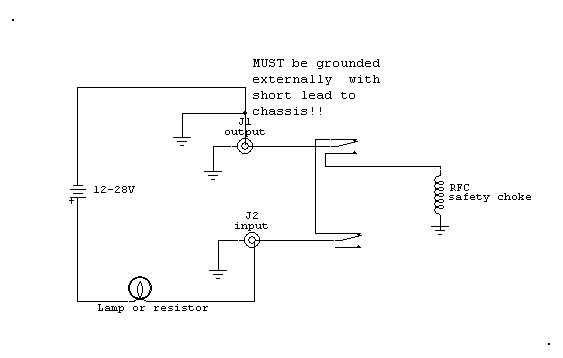
Trace through the schematic or circuit wiring to verify the center pins on the input and output RF connectors have a direct dc path. If the input and output connectors have a dc path, the system is an easy candidate for electrical cleaning.
I recommend using a 12-volt AC or DC supply of around 2-amperes or more as a power source. Whatever source you use, do NOT increase relay current to more than ~10% of relay contact rating. You do not want to pit or burn the contact surface
This means the supply should always have a current limiting resistance, and the supply should never be more than 25 volts.
AC will work as well as dc in this application, and actually AC can be very slightly better.
You MUST ground the output connector at the connector. This prevents feedback through the amplifier from output to input.
1.) Connect the supply through a 10-20 ohm power resistor (5-10 watts), or 12-volt ~one ampere light bulb (like an automotive incandescent brake or turn-signal bulb), to the exciter (radio) input connector of the amplifier or antenna switch. Higher voltages require adjustment in component values.
2.) Ground the amplifier antenna connector center pin, or return the center pin by wire connection, to the opposite terminal of the power supply. This must be grounded at the jack.
3.) Turn the amplifier on, and by closing the relay control line, cycle the antenna relay in and out of transmit a few dozen times. This will almost always completely burn off any film on the contacts without damaging contact plating.
If you have a keyer or other repeating closure device that is within the ratings of the amplifier relay line, you can use it to cycle the amplifier RELAY control line. Set the dot speed to slow rates, and send a long string of dots that cycles the relay.
All Ameritron amplifiers are suitable for electrical cleaning, without removing the cover, so long as they do not have an internal PIN diode switch. Other suitable amplifiers are the Heathkit line, RL Drake (L4 and L7 series), and many others.
If you are brave, have an amplifier with a low-pass or band-pass tuned input,
and have an SWR protected transceiver, it is sometime possible to RF-clean relay
contacts.
1.) Place your amplifier on 160 or 80 meters, and place your radio on 40 meters or
higher (this
assumes an amplifier low-pass style tuned input circuit).
2.)
Place the transmitter in
the FM or RTTY mode
3.) With the amplifier on standby, adjust for about 10-20
watts. DO NOT run more than ~20 watts! Less power is better, but power needs to
be more than 1-2 watts.
4.) With a carrier locked on, cycle the standby-operate switch over-and-over dozens
of times.
I use a similar method to clean remote antenna relays by hot cycling them, but ONLY with ten watts or less.
Note:
Be sure your amplifier has a low pass input circuit
if you use this method. If it does not have a low pass input, you can do the
same thing by simply reversing the input and output leads in a stable amplifier.
This will pass RF through the bypass contacts without allowing the amplifier to
amplify when in the operate position. As a last resort, if none of those are
possible, just cycle normally with 10W steady drive. You do NOT want to risk
arcing the transmit contacts over-and-over. This method is a little more riskier
than steady current cleaning and really works no better.
Mechanical Failures
A less-common failure is contact welding, pitting, or pocking. These types of problems can occur from hot switching, tube arcs, or lightning. in severe cases the relay can weld and stick, and in other cases the surface is damaged resulting in unreliable connections. In any case, even if the relay "un-sticks", the contact surface and delicate thin layer of flashing that allows dry switching is damaged or destroyed. This results in an unreliable relay.
While filing, tinning, burnishing, and other harsh repair methods might temporarily restore operation, plan on replacing the relay.
A second cause of mechanical failure is physical damage. This can be designer error aggravated by carelessness, such as locating a relay where an excessive length cabinet screw can push into the relay. Often times people lose screws, and someone just grabs a random length screw to bolt a foot or cover back on. The designer, through poor hole or parts placement, in essence set the system up to fail. Several commercial amps have screws entering directly in-line with the relay, and just fractions of an inch away. Before closing up any cabinet or changing hardware, look to see what components the screws might hit.
Accidents also happen, so try not to mechanically shock the relay by dropping
equipment. Pack well for shipping, with at least 2 to 4 inches of proper
density closed cell foam supporting any amplifier you ship.