Related articles at
Balun Test contains model of "perfect" dipole currents.
Sleeve Balun shows how a sleeve adds impedance, useful for VHF and higher baluns
Receiving Common Mode Noise shows how lack of a balun can contribute to system noise (it applies to transmitting antennas as well)
Balun and Core selection for transformers and baluns
Transmitting baluns on testing transmitting baluns
Our first common assumption is that RF "in the shack" that distorts our audio, causes computer crashes, or (worse yet) causes RF burns is caused by inadequate station grounding. RF "in the shack" often occurs when we use makeshift antennas, such as a longwire or some other single-wire feed system. Obviously, bringing a longwire or some other antenna directly into the ham shack or placing an antenna near the operating position will cause high RF levels and associated problems.
What may not quite be so obvious is we should never need a station RF ground when using two-wire feed lines. This includes both shielded coaxial cables and unshielded open wire lines. If we have properly operating coaxial feed lines or balanced feed lines, the operating position should have minimal RF even totally absent a ham shack ground! There is one exception to this, direct radiation from the antenna into station wiring can sometimes cause high levels of RF to appear on equipment or wiring.
Contrary to popular belief that only balanced dipoles or balanced antennas need baluns or common-mode isolating devices or systems, verticals and longwires also require "baluns" (more correctly called common-mode chokes or isolators for this application). This article shows why baluns, or more properly common-mode chokes, might be required when using unbalanced feed lines with antennas we consider to be "unbalanced". At the root of this problem is common-mode current on feed lines and other wires and cables.
Current flows because there is a voltage or electrical potential difference between two parts of a system, along with a path that allows current to flow between those points. This path can be through empty space, where special currents (without actual electrons flowing) called "displacement currents" flow, or it can be actual charges moving through things we know to be conductors. Displacement currents are sometimes confusing, or we don't think of them very much. Displacement currents flow between two plates of a capacitor by flowing through a capacitor's dielectric (even vacuum or air). Displacement currents also "flow" between a vertical or single-wire fed antenna and the "ground return system" for that antenna, such as displacement currents between a mobile antenna and a vehicle's conductive body or chassis and the earth around that system.
Displacement currents complete the return current path in antennas. They are the sole reason current in physically large coils can vary from end-to-end, and are especially problematic in mobile antenna installations. They are the reason an open-ended antenna like a dipole, longwire, or vertical is able to have current flow out to the end of the antenna, even though the end just hangs out there in the air with nothing around it!
When we force charges up into a Marconi vertical or longwire antenna (making current flow), we have to move an equal number of charges out of some ground system or counterpoise at the feed point. The ground system can be a single conductor or many dozens of wires, and it can (and often does) involve equipment in the house and/or the coaxial feed line shield. The bottom line is we always must have the same current coming into the feed point from some sort of counterpoise as the current that moves up into the antenna at that point! There is no way around that rule, and this requirement for equal currents flowing into the ground and up into the antenna creates two problems:
Another way to view this is feed lines or feed points of our Marconi (end-fed) antennas must have something to push against to force current into the antenna. It is very much like physically pushing a car. If we have very poor footing, our feet will move and slide as we push. We not only waste energy that could be used to move the car, we have movement or motion where we don't want movement. The same is true for a ground system, as feed line power "forces" current up into the antenna the other terminal of the feed line has to be held steady. We waste energy that COULD be in the antenna, and we have RF movement where we don't want it....on the outside of the coax shield and on anything connected to that shield.
A dipole, even though a balanced antenna, also has problems with common mode currents when fed with an unbalanced feed line. Some feed line lengths can cause problems, while other lengths might eliminate need for a balun. There is no universal magic length to minimize common mode currents because the required length to minimize common mode varies with the routing, grounding, and surroundings of the feed line. If we have a specific case, like a vertical feed line hanging in free air from a dipole and running straight down to earth and grounded at earth's surface, then the magic length is 1/4 or any odd quarter wavelength with no correction for velocity factor required!
If you are not familiar with how coaxial cables work, you might want to look at a simple explanation on this site or one of the ARRL Handbooks.
In order for a conductor like the outside of the shield to not have current flow at radio frequencies, it must have the same electrical potential and phase on the shield's outer surface all along the cable's length. If the feed line has a high series impedance (common mode impedance), or if the potential difference along the conductor is low, very little current will flow on the outside of the shield. Any coaxial feed line, or two-wire twinlead or open wire line, can have unwanted common mode currents.
Does a vertical or longwire present significant common mode voltages to the feeder, voltages that can cause common mode currents? You bet it does! The only vertical (or longwire) that would not cause such problems is one with a very good or nearly perfect ground system, and that means something at the feed point that looks like a large infinite groundplane. Even then, the feed line must exit below that groundplane to be "shield current free". Of course current fed antennas are more of a problem, voltage fed antennas have much less return current at the feed point. Keep in mind though that voltage fed antennas, like an end-fed halfwave, do not have infinite feed impedance. End-fed halfwaves still require a counterpoise, always! People sometimes fail to recognize the counterpoise, but one always must be there or it would be impossible to feed the antenna.
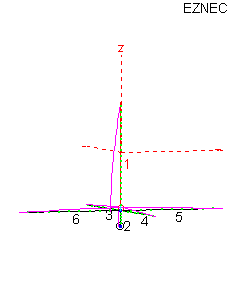
Here is a model of a groundplane with four radials:
EZNEC ver. 3.0
Balun 80 vertical
1/3/04 7:19:05 PM
---------------
CURRENT DATA
---------------
Frequency = 3.6 MHz.
Wire No.
1:
6.700
Wire No.
2:
1.359 (This is your
feed line or mast)
Wire No.
3:
1.985 (These are the
radials)
Wire No.
4:
1.985
Wire No.
5:
1.985
Wire No.
6:
1.985
We can see significant current flows over wire 2, which would be the coax shield, a mast, or both.
There is a trick with Eznec. By inserting an additional source in the mast or feed line and setting current of that second source to zero, we can see the voltage required across a feed line isolator to force current to zero. In this case the voltage across a perfect isolator would be:
| Source 2 Voltage
= 145.5 V. at 67.97
deg. Current = 0 A. at 0.0 deg. Impedance is infinite |
At 1500 watts the radial system common point needs to have 145.5 volts to earth
to prevent current flow along the outside of the shield! If we elevate the common point to 145.5 volts at 68 degrees phase angle, we now have the following currents at 1500 watts:
| Wire No. 1: 6.4 A Wire No. 2: 0 A (coax shield or mast) Radials: 1.58 A each |
How many times have we been told four carefully tuned resonant radials make a perfect zero-resistance ground? Obviously any claims that four resonant radials create a near-perfect ground reference are not true. With four radials the antenna might have high efficiency, but the antenna is not perfectly unbalanced. Since the antenna is not perfectly unbalanced, we cannot connect a feed line without some feed line lengths or feed line grounding arrangements causing appreciable unwanted current to flow over the coax shield.
You can see an example of this in this link to groundplane antennas.
With fewer radials the situation becomes much worse! (As a matter of fact, this is a good reason to use as many radials as we can even if the radials are resonant.)
Claims that four elevated radials form a "perfect ground better than 120 radials" are obvious nonsense! If it was a perfect ground, there would be no potential difference to earth and no common mode current flowing to "real ground" ! Four radials may be a reasonably good ground when elevated a considerable distance above lossy media, but it is not zero impedance.
If the antenna has a high base impedance, it will have less current at the feed connection. (Sorry, but we cannot do this by using a folded unipole!)
Longwire and Windom antennas really aren't much different than verticals. They are a form of Marconi antennas, and require a counterpoise or ground of some sort. As with verticals, common mode current flowing into the antenna must be balanced by current flowing into a ground system. You can see how that works at this link to end-fed antennas.
Instead of bringing the longwire directly to an antenna tuner, a better solution is using an RF ground system independent of the station safety ground, and keeping that ground isolated from the station safety ground. That can be accomplished by adding a good heavy-duty 1:1 choke or current balun a few feet from the tuner, and connecting the RF ground to one output terminal and the antenna to the other terminal. With a two-wire fed Windom (really an OCF dipole), the two wire feeder should connect to the choke balun or isolator and then to the antenna.
The balun MUST be a current balun, rather than a voltage balun. The balun or isolator should be at or near the base of the antenna. In tough situations a second choke 1/4 wavelength away will help.
The cure for common mode problems caused by less-than-perfect or smaller ground systems is inserting a good 1:1 choke balun in the system at the antenna feed point. The coax should also be kept away from the radials as it exits the area of the radials and the antenna. An antenna with a poor ground using few radials cannot have a support mast grounded to the radial common point (at least it shouldn't if designed properly). There is no exception to this! A radial system of 25 or more full-size radials would likely have minimal common mode on an unbalanced feeder, but current rapidly increases as the ground system becomes smaller.