[ Home ]
End fed longwire or random wire antenna
Warning about antenna models!
The dipole is the basic building block of many antennas. A dipole does NOT have 2.2 dB gain over an isotropic radiator when the dipole is placed over earth. The dipole has about 8.5 dB gain over an isotropic radiator! Always remember this when you see antenna models over earth given in dBi. If the model over earth shows a "gain" of about 8.5 dBi, the model effectively has the same gain as a dipole.
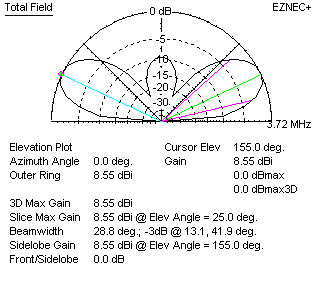
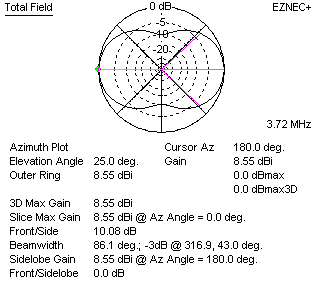
Here is the pattern of a 145-foot high copper wire dipole over medium real earth on EZNEC:
You can see the gain is 8.5 dBi, and it is just a simple dipole just over 1/2 wave high. Any antenna you model should always be compared to a standard like this!
The notion a dipole has around 2.15 dBi gain is only true for freespace.
Receiving: Contains information in many articles. Receiving antennas including Beverages and Beverage Antenna Construction, Loops, K9AY, Pennant, Flag, EWE, Slinky Beverage Antennas, vertical arrays, magnetic loop antenna, and terminated loop arrays.
Transmitting: Pictures of some transmitting antennas at my station. Most transmitting antennas link from the top of this page.
Balun and Core Selection: Contains information on core selection for transformers and baluns
Baluns, Sleeve balun: How they work
Baluns, transmitting: What they do, how they do it, and how to test them
Balun, Toroid: Winding style, debunking split-winding will improve performance
Crossfire Phasing: Contains information on cross fire phasing and why it is superior for broad bandwidth arrays
Combiner and Splitters: Contains information on Magic-T splitters and combiners, how they work and what they do
Curtain Arrays: USIA and Distributed Feed Curtains, Sterba Curtains, Lazy H antennas and other curtain antennas
Detuning Towers: A quick explanation of how it works and the incorrect idea that you adjust for minimum current! Pass this along, it is a major error to tune for minimum current!
EH antenna: the E-H and CFA antennas. How they work.
Inductors, Loading: A brief tutorial on loading inductors
Mobile and Loaded Antennas: Small loaded antenna systems
(Related page: Inductor spice model)
Short Antennas and feed line loss: Remember to include feed line losses in models
Omega and Gamma Matching: Contains technical information on Omega and Gamma matches and matching, impedance limits, component selection, component failures
Radiation and Fields: What the terms we use actually describe
Radiation Resistance: A revised (as of Feb 14, 03) tutorial on radiation resistance and how it is used and misused
Rohn Tower: How we installed various Rohn towers by lifting with a crane
Rohn 65G: How we built a gin pole or erection fixture for Rohn 65G, and the final result
Rhombic antennas: Models and theory of a rhombic antenna
Traps: Measurements and operation of traps and trap antennas. Including trap antenna loss.
since May 2004
©2003,2004 W8JI